Specs your coding agent can actually run.
The spec layer that pushes back on your rough plans until they're ready for Cursor, Claude Code, Codex, and Copilot.
For builders shipping with Cursor, Claude Code, and Codex.
Coding got faster. Planning did not.
Where Speqtra fits
The missing loop around the AI coding stack.
Teams already understand the coding side: Cursor is the AI editor, Claude Code and Codex are coding agents, and Copilot sits inside the IDE. Speqtra owns the spec layer before them: argue rough plans into structured specs, then hand them off through the CLI.
Today
Call notes
Feature ideas, rough requirements
???
Copy-paste into ChatGPT and hope for the best
Cursor / Claude / Codex / Copilot
Uses vague tasks to implement
Code
Implemented. But was it the right thing?
With Speqtra
Call notes
Feature ideas, rough requirements
Speqtra
Creates the product spec
Speqtra CLI
Delivers the spec into the dev environment
Cursor / Claude / Codex / Copilot
Uses structured specs to implement
Code
Implemented product changes
Why not just use Claude?
Not another chat box for writing specs.
ChatGPT or Claude can draft a spec. Speqtra is the workflow around it: codebase context, clarifying questions, task generation, and a CLI that delivers structured specs into your dev environment.
Codebase grounded
Specs based on the repo you actually have.
Every speqtra index refreshes a project view of your models, routes, dependencies, and conventions. The planner shapes tasks around your existing code instead of inventing generic boilerplate.
Project index
models
Task, Project, Comment, Activity
routes
/projects/[id], /api/planner/chat
dependencies
next, prisma, better-auth, ai
conventions
file structure, naming patterns
Why this exists
Model isn't the bottleneck. Input is.
Cursor, Claude Code, Codex, and Copilot. The coding side moved fast. The plan is still a Google Doc. The handoff is still a Jira ticket.
Agents don't ask clarifying questions.
A human dev reads between the lines. A coding agent takes your task literally. Vague in, wrong out.
Tasks have no context.
Requirements live in chat. Tasks land in your tracker with half the context lost. Agents execute vague work.
Every agent builds a different mental model.
Two devs, two agents, same vague task. Three different implementations. Without a shared spec, your codebase forks before merge.
Planning flow
From rough intent to buildable product spec.
Ask the product questions
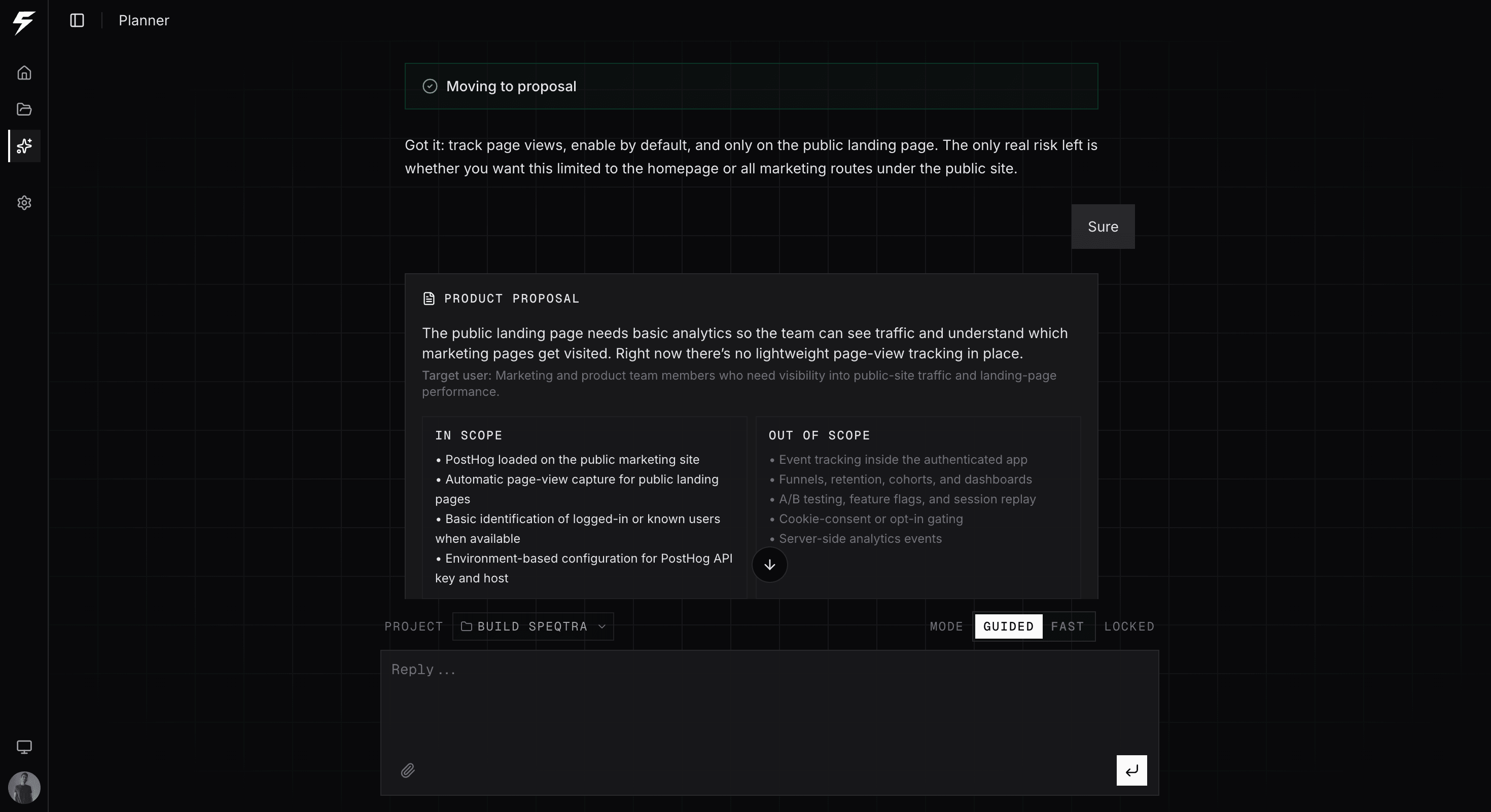
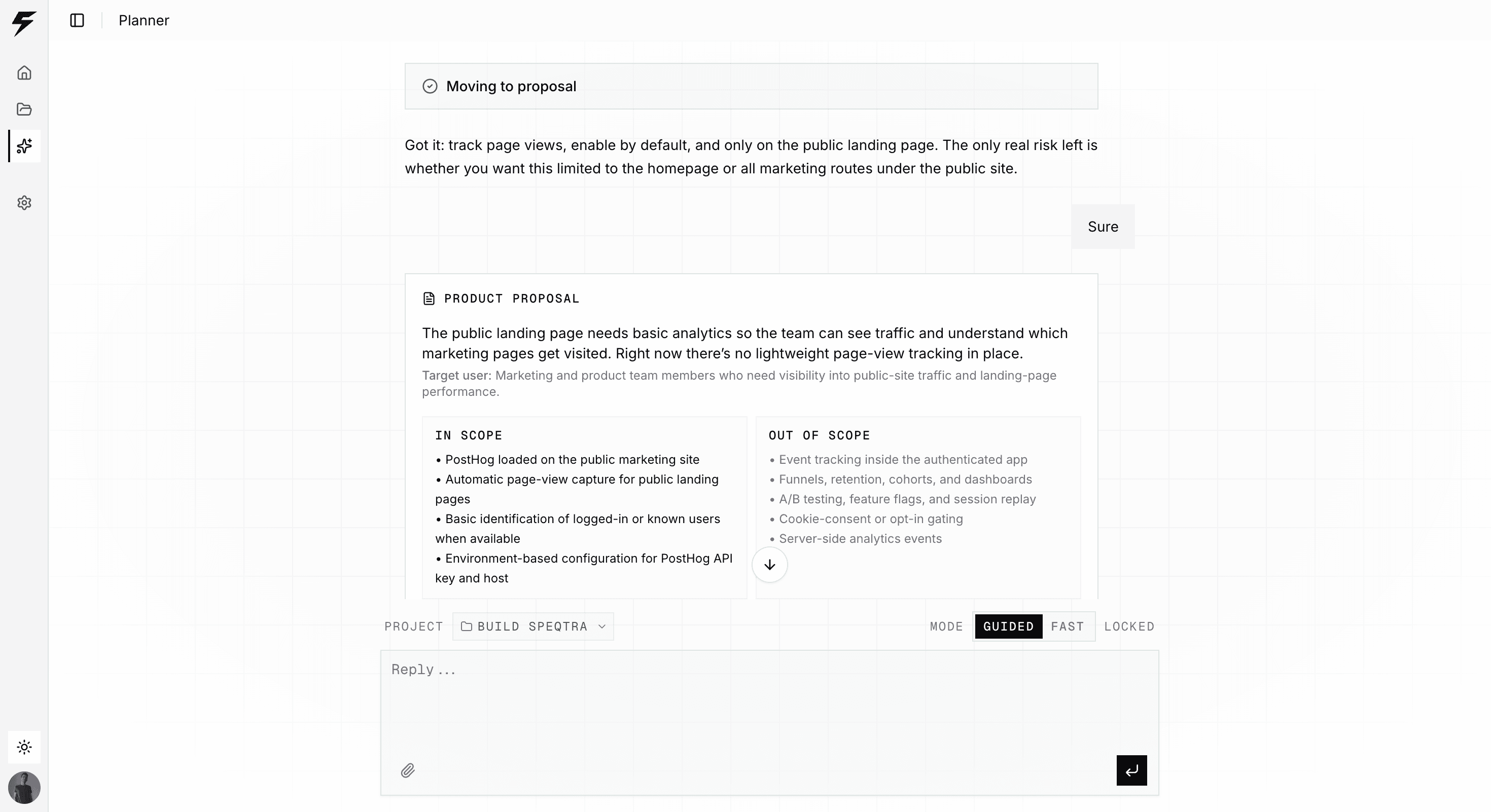
Before tasks are created, Speqtra pushes back on unclear requirements: who the users are, what edge cases matter, what constraints exist, and what success looks like.
Shape a spec
The output is structured around scope, requirements, scenarios, and what should stay out.
Create the task list
Once the spec is approved, Speqtra turns it into project tasks instead of another loose chat transcript.
CLI handoff
Specs travel to where the code gets written.
speqtra take picks up a task, writes the full spec locally, and injects it into Claude Code, Cursor, and Codex config. Copilot can read the generated spec.
$npm install -g @speqtra/cliGitHub →Private beta
Bring one real task.
Bring one messy task. Built for builders shipping with Cursor, Claude Code, and Codex who are tired of vague tasks producing wrong output.